
Destinations
Bhutan
Discover the culture, landscapes and stories that make Bhutan unforgettable.
Discover Bhutan
A journey that stays with you.
Bhutan, a global leader in sustainability, is the world’s first carbon-negative country. It is also the only nation that measures progress through Gross National Happiness rather than GDP—placing people, planet, and purpose at the heart of its development. For conscious travelers seeking a meaningful and transformative experience, Bhutan stands out as a truly unique destination.
The best time to visit Bhutan is during spring (March to May) and autumn (September to November), when the weather is pleasant, skies are clear, and the country comes alive with vibrant festivals and stunning natural beauty. That said, if your journey focuses on destinations such as Paro, Thimphu, and Punakha, Bhutan can be explored year-round—each season offering its own distinct charm.
JOURNEYS THROUGH BHUTAN
Bhutan itinerary
Highlights of Bhutan
PARO – THIMPHU – PUNAKHA VALLEY – PHOBJIKHA VALLEY - PARO
Day 1: Arrival at Paro and drive to Thimphu (1hr) (Dinner included)
Welcome to Bhutan. Upon arrival at the Paro International airport, after a very scenic flight, and Visa/Permit formalities, you will be received by our company representative in Bhutan, and together you will drive to Thimphu,
the capital city of Bhutan.
On the way, you will pay a quick visit to Tachogang, also known as Tachog Lakhang, which means ‘the Temple of the Hill of the Excellent Horse’. This temple was built by the legendary Thangtong Gyalpo (1385-1464), who
is also said to have built the 58 iron chain suspension bridges, 60 wooden bridges, 118 ferries, 111 stupa monuments, and countless temples around Tibet and Bhutan.
Once in Thimpu, after checking into the hotel and lunch, you will drive to the ruins of Kuensel Phodrang, where, amidst the ruins, is built the Great Buddha Dordenma (the largest statue of Shakyamuni Buddha in Bhutan, celebrating
the 60th anniversary of the fourth king Jigme Syngye Wangchuck).
You can also see a magnificent view of the Thimphu Valley. From here, you will then drive to Takin Sanctuary to see the national animal ‘Takin’ of Bhutan. After visiting the Takin Sanctuary, you will drive to Sangaygang
to enjoy the beautiful view of the Thimpu city. Dinner and overnight in a hotel in Thimphu.
Day 2: Drive from Thimphu to Punakha and explore Punakha (Breakfast, Lunch, Dinner included)
Breakfast in Thimphu, and you will drive to Punakha, the former capital of Bhutan. The road to Punakha is a treat in itself, as it climbs steeply through the forest of pine and cedar and is festooned with hanging lichen higher
up near the Dochula pass (3,050m).
You will stop for a while at this pass to visit Druk Wangyal Chortens (108 memorial chorten built by Ashi Dorji Wangmo Wangchuk, the eldest Queen Mother); to enjoy the panoramic views of the snow clad mountain peaks of the
Himalayas, which includes Mt. Masanggang (7,194m) and Mt. Gangkar Puensum (7,570m), the highest peak in Bhutan and to enjoy a short tea break.
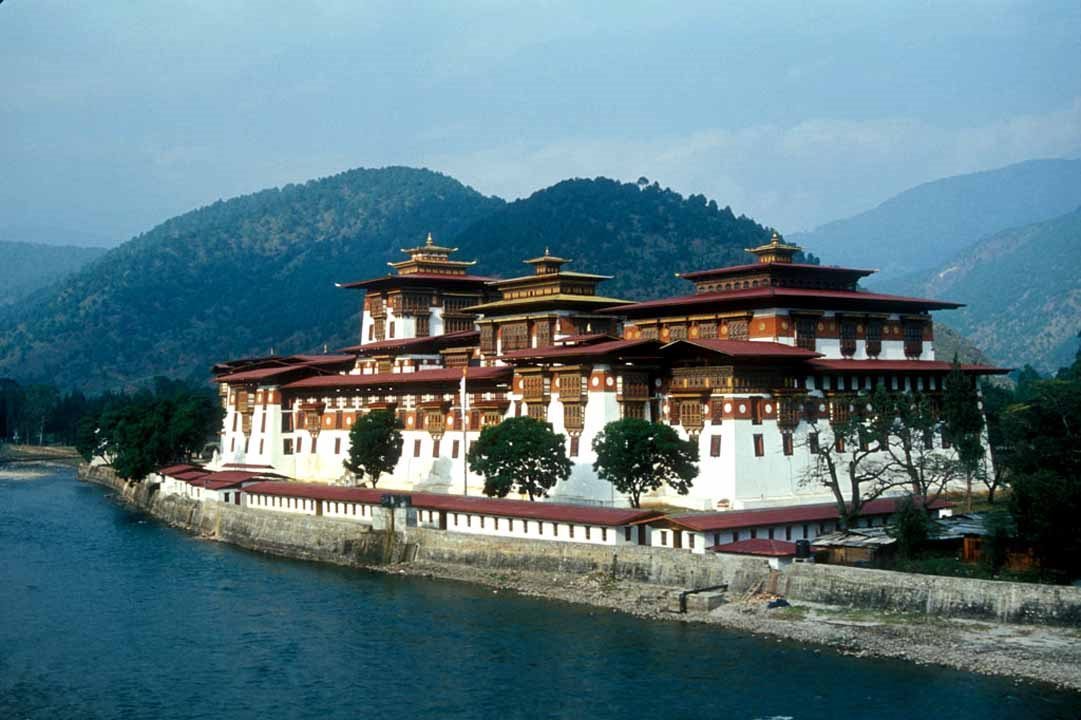
You will then continue down to Punakha. Once in Punakha, you will visit Punakha Dzong (located between the Pho Chuu and Mo Chhu Rivers), the second-oldest and second-largest dzong in Bhutan and currently the administrative
center of Punakha District.
After visiting the dzong, you will drive toward the north of Punakha valley and hike for about 50 minutes to see the Khamsuum Yuelley Namgyal Chorten, a temple built to remove negative forces and promote peace, stability, and
harmony in the world. Taking in the wonderful views of the Mo Chuu River and the mountain peaks of Gasa and beyond, you will hike down to the transportation waiting for you.
In the afternoon, you will visit Sangchhen Dorji Lhuendrup Nunnery, a newly built, traditional-styled, nunnery standing 1,550 meters atop the hill. Although, the nunnery is newly built, the site has a long and legendary history.
Dinner and overnight in a hotel in Punakha.
Day 3: Sightseeing in Punakha (Breakfast, Lunch, Dinner included)
After breakfast, you will set out to visit the attractions in Punakha. You will start with a trip to Chorten Nebu, which is a little-known treasure, built in the eighteenth century. It houses a magnificent statue of Maitreya
(the future Buddha) and fine images of great lamas of Drukpa Lineage. You can either choose to drive, or hike to this chorten.
If you choose to drive, it’s a half-hour drive from Punakha Dzong, however, if you choose to hike, it’s about a 2-3 hour walk on a steeply winding uphill trail all the way up to the Chorten Nebu.
Here, you will also visit the Chorten Nebu Monastic School that houses poor orphans from the nearby villages and makes provision for them to study both traditional Buddhist scriptures and texts and modern subjects like, Science,
English, Mathematics, etc. In the afternoon, you will visit Chimi Lakhang, a Buddhist monastery built in the 14th century. Later, you will drive to Ritsa Village, which is famous for the unique technique it uses to grow
rice. During the monsoon, the tour of the vineyard can also be added to the itinerary. The village also has a monastery that grabs the attention of the visitors with its splendid architecture and centuries-old religious
tradition. Dinner and overnight in a hotel in Punakha.
Day 4: Drive from Punakha to Phobjikha Valley (Gangteng) and explore the valley (Breakfast, Lunch, Dinner included)
Breakfast in Punakha, and you will drive to the Phobjikha Valley, a picturesque and quiet valley in Wangdue Phodrang district in Bhutan. This valley is also the winter home of the globally threatened black-necked crane (Grus
nigricollis), that migrate from the Tibetan Plateau around the last week of October and stays until mid-February, or even March.
In Phobjikha, you will visit the Gangteng Monastery (an important monastery of the Nyingmapa school of Buddhism that dates back to the 15th century), located atop the hill amidst the Gangteng Village. The view of the valley
from the monastery is mesmerizing.
Shortly after visiting the monastery, you will start to hike the very famous shortest ‘Gangte Nature Trail’ that starts from the Gangteng Gompa and heads downhill through flower meadows to Semchubara Village and enters
through beautiful forest to the open valley. After passing a chorten and Khewa Lakhang, the trail ends at the local community school.
From here, you will drive to the lodge in Gangtey.
Dinner and overnight in a lodge in Gangteng.
Day 5: Drive back to Paro (Breakfast, Lunch, Dinner included)
After breakfast, you will drive to Paro via Dochula Pass. On the way, you will stop to visit places that you missed earlier and stop for lunch in one of the local restaurants.
After lunch, you will drive to Gimina village to visit Tara (Dolma) Monastery, which was constructed to recreate positive Karma benefiting all sentient beings and bring peace and happiness to Bhutan as well as the world.
After visiting the monastery, you will drive for about 20 minutes to begin your short Zuri hike. A 20-minute hike will take you to the viewpoint that presents a very wonderful view of the Paro Dzong and the river below it.
A further 20-minute walk and you will reach the Zuri Dzong. From here you will descend towards the Paro Dzong for about 4 kilometers, cross the cantilever bridge, and drive back to the hotel in Paro.
Dinner and overnight in a hotel in Paro.
Day 6: Hike to Taktsang Monastery (Tigers Nest) and explore Paro (Breakfast, Lunch, Dinner included)
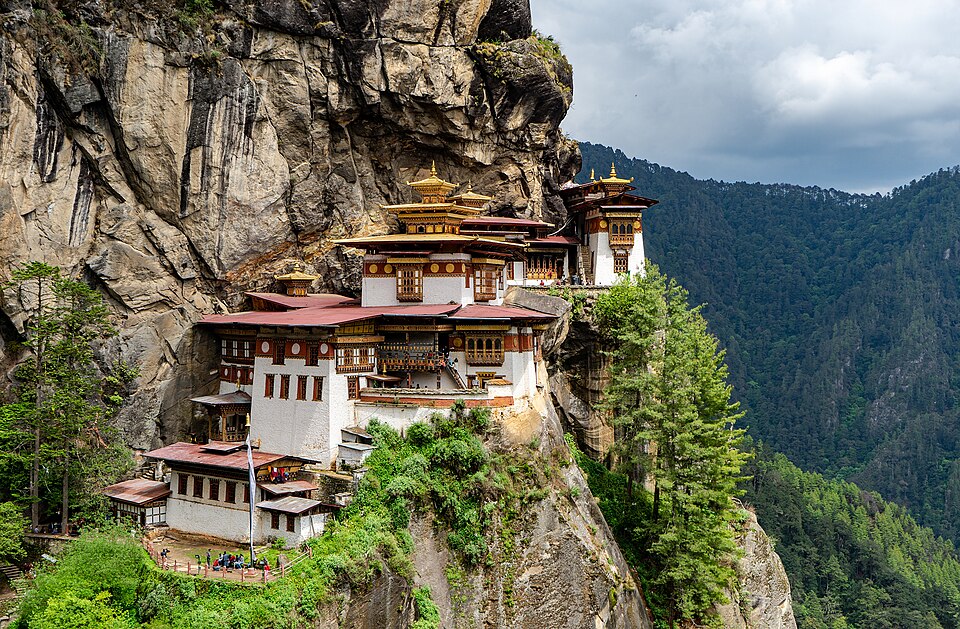
After breakfast, you will drive to Ramthangkha, to start your hike to Taktsang Monastery. About 2 hours hike to take you to the cafeteria and the viewpoint, from where, you can enjoy the stunning view of the monastery, where
Guru Padmasambhava landed on the back of a tigress in the 8th century. After a short rest at the cafeteria, a 1.5 to 2-hour hike will take you to the Tiger’s Nest Monastery.
You will visit the temple and hike down to the cafeteria for lunch.
After lunch, you will further hike down to the trail head where the trail meets the road and drive to visit Kichu Lakhang, built in the 7th century and is one of the oldest temples in Bhutan. If you are interested, you can
also take an archery lesson near the temple.
In the evening, you will spend your time strolling through the town of Paro. Dinner and overnight in a hotel in Paro.
Day 7: Departure (Breakfast included)
After breakfast at the hotel, as per your airport reporting time, you will be driven to the airport.
Bhutan itinerary
Enchanted Bhutan
PARO – THIMPHU – PUNAKHA – PHOBJIKHA – BUMTHANG – PARO
Day 1: Arrival at Paro and drive to Thimphu (1hr) (Dinner included)
The flight into Paro presents you with a wonderful view of Everest, Kanchenjunga, and the peaks of the Eastern Himalayas. Your guide will be there to meet you at the airport and accompany you to your hotel. The drive to Thimphu
takes about one hour, following the river the whole way. Welcome to Bhutan!
If time permits, visit the impressive Thimphu Dzong (Trashichodzong). Especially at nighttime, you will get a nice picture of the dzong. In case of delays, visit the Dzong the next day.
Overnight in Thimphu.
Day 2: Morning excursion to Tango Monastery & afternoon sightseeing (Breakfast, Lunch, Dinner included)
Drive out of Thimphu towards the end of the valley for a short hiking excursion to Tango Monastery. It is a one-hour uphill climb to the monastery, which is also an Institute for higher Buddhist studies and a centre of meditation.
Many meditation huts are scattered on the mountainside surrounding Tango. Cheri monastery, situated on a steep mountain opposite Tango, is a centre purely for meditation and, therefore, it is left undisturbed.
You have the option to have a picnic lunch on this excursion or to return to Thimphu for lunch in a restaurant.
Back in Thimphu, visit the Folk Heritage Museum, see a traditional Bhutanese farm house, and the everyday implements used in farm life. Then visit the Institute for the 13 Traditional Arts (Zorig Chusum), where you can see
young Bhutanese at work on their chosen craft, such as mural painting, statue-making, or wood-carving.
Then drive up through Mothithang to the Takin reserve on the outskirts of town. The Takin is the national animal of Bhutan. From here, continue to the viewpoint, festooned with prayer flags. For those who like hiking and, if
time permits, you can take a 50–minute round–trip hike to Wangditse temple and get some nice views looking down on the Thimphu dzong.
Evening, take a stroll to the Memorial Chorten where you will see people of all walks of life who have come to chant their prayers and spin their hand-held prayer wheels.
Overnight in Thimphu.
Day 3: Morning in Thimphu & drive to Punakha (2½ hours plus stops en route) (Breakfast, Lunch, Dinner included)
Before driving to Punakha, visit the Institute of Traditional Medicine, which is much visited by the Bhutanese for consultation with the doctors. Here, there is a modest display of the products used in medicine, or visit the
Chang-gangkha temple, a popular local temple where parents bring their newborn children to get a blessing and a name from the lamas.
Drive to Punakha. On the way, stop at Dochula pass (3000m) to enjoy the view of the mountain ranges and the 108 chorten that are situated right at the top of the pass. Drive to Hotel and after lunch continue your sightseeing.
Drive back & then descend to 1,200m and visit Chimi Lhakhang, the temple of 15th Century Lam Drukpa Kuenley, the “Divine Madman”. Your guide will tell you more about his unconventional teachings. Take a lovely stroll through
rice fields and villages in this semi-tropical region.
Overnight in Punakha.
Day 4: Full day sightseeing in Punakha (Breakfast, Lunch, Dinner included)
Discuss with your guide about today’s choice of activities, which are designed to take you into the peaceful countryside where you can enjoy nature. We suggest a morning driving and hiking excursion to Talo monastery. Drive
through beautiful scenery up to Talo monastery. Depending on your energy levels, you may wish to walk for some distance along the country roads that pass through farming villages.
In the afternoon, make the most of the pleasant spring weather and drive beyond the dzong and hike to Khamsum Yulley Namgay chorten (This is a short hike of about 30 – 45 mins uphill.) From here, you get beautiful views of
the valley below.
On the way back, visit Punakha Dzong, which was the old capital of Bhutan until 1951 and the place where, in 2008, our 5th King received a special empowerment blessing before going on to be crowned in Thimphu. The Dzong sits
at the point where two rivers meet. These rivers are named the “po-chu” and “mo-chu” (female and male rivers). The impressive cantilever bridge that gives access to the Dzong is a very recent reconstruction of the original.
The Dzong is the setting for the Punakha Dromche festival in February, in which locals and monks re-enact the battles between the Bhutanese and Tibetan invaders who came in pursuit of the Shabdrung Ngawang Namgyal and the
precious relic that he had in his possession.
Overnight in Punakha.
Day 5: Drive to Phobjikha via Wangdue (4 hours) (Breakfast, Lunch, Dinner included)
Drive from Punakha following the Punatsangchu river until you reach the Wangdue bridge. From here, a winding ascent begins towards the ridge on which the now-ruined Wangdue dzong sits.
Wangdue has seen many recent changes. The original small town, strung along a high ridge, had an air of the Wild West about it, with its simple wooden houses lining the curved road. However, late in 2011, this town was demolished,
and all the residents relocated to the “new town,” laid out in a grid pattern near the river. Then, in June 2012, Wangdue Dzong, was burnt down in a tragic fire. Wangdue Dzong used to dominate the ridge and was the only
Dzong in Bhutan that retained its traditional shingle roof, weighted down with stones. Now, only the charred remains are to be seen, but you can still get an impression of the magnificence of its location. Plans are already
afoot to rebuild the dzong as soon as possible.
Continue to Phobjikha, a wide, high glacial valley with an area of marshland that is a nature reserve. Visit Gangtey Monastery, the only Nyingma monastery in western Bhutan. Most Nyingma monasteries are in the eastern part
of Bhutan. It is difficult to notice any difference between Nyingma and Kargyu monasteries. Kargyu is the national religious sect of Bhutan and Kargyu monasteries are fully state-funded. In terms of tradition, Nyingma is
one of the oldest sects of Buddhism originating in Tibet. This monastery has just undergone a full restoration. Until recently, there was only solar-powered lighting in this valley because it is a reserve for the rare black-necked
cranes, which migrate to Bhutan from Tibet to make this valley their winter home, but now the villagers have been provided with underground cables.
From the temple, take a gentle walk on the Nature Trail, skirting the forest and passing through small villages. During the winter months (late Oct – end Feb), this is the best way to see the rare Black-necked Crane. A stroll
through the village is sure to end in an encounter with the local village children, who are always curious to see you.
Overnight in Phobjikha.
Day 6: Day hike in Phobjikha valley (Breakfast, Lunch, Dinner included)
Day hike in Phobjikha valley with a packed hot lunch from the hotel. Optional extra to have bicycle riding for like half day/1 full day or hourly basis. Discuss with your guide.
Overnight in Phobjikha.
Day 7: Drive to Bumthang (5 hrs) (Breakfast, Lunch, Dinner included)
Set out early on the drive to Bumthang. After a short drive, you will cross the Pele-La Pass (3500mts). En-route stop at Chendibji Chorten, a stupa in the same style as found in Kathmandu. Lunch will be served at Chendibji.
A long, winding drive leads to Trongsa, a small town with an impressive Dzong perched on a promontory that used to control the gateway between east and west of Bhutan. Visit the Dzong and the museum. A two-hour drive from
Trongsa brings you to Jakar town in the Bumthang valley.
Overnight in Bumthang.
Day 8: Full day sightseeing in Bumthang (Breakfast, Lunch, Dinner included)
Today, you have various options for short hikes and sightseeing. You can discuss with your guide and carry on the tour as preferred.
Options:
Sightseeing, visit Jambay Lhakang, Kurjey Lhakang and Tamshing Lhakang as well as the Jakar dzong.
The religious heartland of Bhutan, Bumthang is full of temples and sites of pilgrimage, many of which are related to Guru Rimpoche and PemaLingpa the renowned “Treasure-Revealer.” JambayLhakhang, like Kyichu Lhakhang in Paro
is one of the oldest temples in Bhutan and is associated with the legend of the Himalayan demons who was terrorizing the whole region in the 7th Century. Jambay Lhakang pins down her left knee. You will usually find some
ritual or activity taking place here. If you like walking, start your day early and take a pleasant stroll along the country lane between Jambay and Kurjey Lhakhang (approx 30 mins). Kurjey Lhakhang commemorates the first
visit of Guru Rimpoche to Bhutan, and the temple complex has three important buildings from different historical periods.
Take a short 40- minute walk across the river from Kurjey Lhakhang to Tamshing monastery, an old temple in some disrepair but important in the story of Pema Lingpa. Test your strength (physical and moral) with the chain mail
cloak kept inside the old temple building. Here your car will be waiting to return to town.
Tourists seldom visit the old village of Chamkar, which is accessed off the main square in Jakar town but a walk through the cobble-stoned village is very interesting to get an idea of the Bhutanese way of life. The old houses
found here are packed very close together but there is still a place for tiny cultivated plots.
Day excursion to Tang valley & Lake Membartsho.
Today, make a day-excursion (with a picnic lunch) along country roads to Ugyen Choling Palace museum in the Tang valley. The 16th century palace has been converted into a museum of daily life (and also a small guesthouse).
The road is very rough for about 27km. If you like walking, you can stretch your legs anywhere along this route.
Returning from Tang, along a rough farm road, stop to visit another renowned spot linked to the saint and “treasure revealer” Pema Lingpa. A short climb down towards a gorge reveals the mystical ‘burning lake’ at Membartsho,
where the saint Pema Lingpa discovered a ‘terma’ (religious treasure) hidden by Guru Rimpoche by jumping into the deep water with a burning butter lamp in his hand. Your guide will elaborate on the story.
Afternoon visit Jakar Dzong, Kurjey, and Jambay Lhakang. (Description as mentioned above)
Day excursion to Kunzangdrak monastery and visit lake Membartsho, visit Jakar Dzong or the ruined Wangdicholing palace.
Set out from Petsheling Monastery on a pleasant hike at an average altitude of 3,000m. A picnic lunch will be provided. Reach Kunzangdrak Monastery, which was founded by Pema Lingpa and is a very sacred place for the Bhutanese,
possessing a footprint of Pema Lingpa himself conserved in the rock. From Kunzangdrak, descend towards the road and into the Tang valley. From here, time permitting, you can drive to Ugyen Choling Palace museum. The 16th
century palace has been converted into a museum of daily life (and also a small guesthouse).
Returning from Tang, along a rough farm road, stop to visit another renowned spot linked to the saint and “treasure revealer” Pema Lingpa. A short climb down towards a gorge reveals the mystical ‘burning lake’ at Membartsho.
Here, Pema Lingpa discovered a ‘terma’ (religious treasure) hidden by Guru Rimpoche by jumping into the deep water with a burning butter lamp in his hand. Your guide will elaborate on the story.
Return drive to Jakar and visit Dzong high on a hill overlooking the town, or visit the ruined and deserted Wangdi- choling palace, is interesting to see because of its historical importance, though it is in a ruined state.
The huge boxes used to store the rice are still in the courtyard. Enter from the back to see the huge water-propelled prayer wheels.
Half-day uphill trek to Tharpaling monastery (3,000m) & Jamabay Lhakang.
Hike to Tharpaling Monastery. Set out from a spot near Jakar Dzong on an uphill hike that leads to Tharpaling monastery perched on the mountain at 3,000m (4 hrs). This is quite a strenuous uphill hike through the forest, but
very pleasant, affording good views of the Himalayan peaks in the distance. Take a picnic from the hotel. Visit the monastery at Tharpaling. Your vehicle will meet you at the monastery. Wander around the small villages
and farms in the Chumey valley before returning.
Visit Jambay Lhakang. (Description as mentioned above)
Some of the Bumthang hotels have hot-stone baths, so you might like to experience this traditional Bhutanese custom (book well in advance). And, while in Bumthang, be sure to try the locally produced Bumthang honey, apple juice,
and Swiss-style cheese as well as various apple liquors and Panda beer.
Overnight in Bumthang.
Day 9: Fly by domestic flight to Paro (Breakfast, Lunch, Dinner included)
In Paro, visit the Ta Dzong Museum. The museum used to be housed in the magnificent old watch-tower above the Dzong, but since the earthquake of September 2011 damaged the structure of the watch-tower, a smaller collection
of items is displayed in a building nearby.
Then descend on foot to the impressive Rinpung Dzong, which is the administrative centre and home to the monk body. You may recognize the dzong as the one shown in Bertolucci’s “Little Buddha”. Finally, stroll across the traditional
bridge into Paro town, where you can enjoy some free time at leisure in the town.
Overnight in Paro.
Day 10: Hike up to Taktsang Monastery (Breakfast, Lunch, Dinner included)
Today, take an early morning hike up to Taktsang Monastery, perched on the edge of a steep cliff. This is a highlight of the tour since Taktsang is a pilgrimage site for Buddhists from all over Asia, and particularly Tibet.
Guru Rimpoche, who introduced Buddhism to Bhutan, is said to have reached this place on the back of a flying tigress. Take care on the approach to the temple, the route is quite narrow. The round trip takes about 4 hours.
Return to the hotel for lunch.
Afternoon, enjoy the beautiful mountain and forest scenery as you drive along the quiet valley roads towards the ruined fortress, Drugyel Dzong, built to commemorate victory over the Tibetan invaders. On a clear day, you should
get a view of Mount Chomolhari from here. If time permits, stop at a traditional farmhouse to get a taste of traditional Bhutanese life.
Driving back towards Paro town, stop to visit Kichu Lakhang, one of the oldest temples in Bhutan, with a history and legend linking it to the wider world of Buddhism.
Overnight in Paro.
Day 11: Departure (Breakfast included).
Transfer to the airport for the flight departure from Paro.
*********************